


AI chatbots for Turkish businesses are becoming a practical way to turn online attention into real conversations. A buyer may find your brand on Google, visit your website, open Instagram, send a WhatsApp message, and then return later through email. A smart chatbot keeps that journey simple. It can answer common questions, capture leads, guide customers, and support sales teams.
For Turkish companies speaking to a UK or global audience, the first reply matters. Clear English, quick answers, and a smooth next step build trust from the first visit.
What Is an AI Chatbot for Business?
An AI chatbot is a digital assistant that can talk with users through a website, WhatsApp, Instagram, Messenger, or another chat channel. It reads the question, understands the intent, and gives an answer based on the business content it can access.
A modern AI chatbot for business can work with FAQs, product pages, CRM data, booking forms, and support content. A visitor can ask, “Which package is right for me?” or “Can I book a call this week?” The chatbot can guide them, collect details, and pass the conversation to the right team.
For a Turkey-based company, one system can guide Turkish users and English-speaking buyers across tourism, clinics, real estate, e-commerce, education, and B2B exports.
AI chatbots vs scripted chatbots
Scripted chatbots work like a menu. They ask users to click a set path. This can work for simple tasks, such as opening hours or delivery areas.
AI chatbots understand natural questions. They read intent, answer in a conversational tone, and guide people across flexible journeys.

Why AI Chatbots Matter for Turkish Businesses in 2026
Turkey has a large digital audience, strong mobile use, and a fast-growing e-commerce market. Many buyers now expect quick answers before they fill in a form or make a call.
That makes AI chatbot Turkey adoption a natural next step. A chatbot can greet visitors, answer questions, and move each person towards a quote request, booking, product page, WhatsApp chat, or call with the team.
For companies targeting the UK and global markets, clarity matters as much as speed. A UK buyer wants simple English, direct answers, and a clear next step. Strong digital marketing, SEO, content, and Digital PR attract traffic. Chatbots turn that traffic into useful conversations.
Turkey’s digital market creates strong chatbot demand
Turkey’s online audience is active, mobile, and comfortable with messaging. Many customers move between social media, Google, websites, and chat apps during the same buying journey.
This is why a WhatsApp chatbot for business can work well for Turkish brands. WhatsApp feels familiar, website chat feels instant, and Instagram DMs feel easy for discovery.
UK and global buyers expect simple digital communication
A UK or global buyer may compare several brands in one session. They check the website, reviews, social content, search results, and brand story.
This is where conversational AI for business becomes useful. It can answer in polished English, explain the next step, and use approved brand language.
How AI Chatbots Capture Leads
A lead generation chatbot is designed to turn interest into contact details and useful context. It can appear on a landing page, pricing page, service page, blog, WhatsApp button, or paid ad journey.
Instead of asking every visitor to fill in a long form, the chatbot can start with a simple question: “What would you like to achieve?”
Strong chatbots for lead generation can collect:
- Name and email
- Country or city
- Service interest
- Budget range
- Timeline
- Preferred contact channel
- Booking preference
- Company size
This is useful for Turkish companies that receive mixed enquiries from local, UK, and global audiences.
Qualifying questions and CRM routing
A chatbot becomes more valuable when it connects to CRM. That is where AI lead qualification creates structure.
For example, the chatbot can ask:
- What solution are you interested in?
- Are you contacting from Turkey, the UK, or another market?
- Would you like a call, a brochure, or a WhatsApp follow-up?
- What timeline are you working towards?
- Which department should contact you?
Once the answers are collected, the chatbot can send the lead to the right pipeline: sales, customer care, or management.
Appointment booking and follow-up
A chatbot can also guide users straight into a booking. This works well for clinics, real estate firms, agencies, consultants, hotels, schools, and B2B companies.
The user asks a question. The chatbot answers, invites a call or consultation, sends confirmation, and adds the details to CRM.

How AI Chatbots Improve Customer Support
A customer support chatbot can answer frequent questions and guide customers through common tasks. It can cover opening hours, order updates, appointment changes, delivery details, returns, documents, product care, and account information.
Many users ask the same questions every week. A chatbot can answer them quickly and keep the team focused on conversations that need human attention. For a growing business, AI customer service can create a cleaner experience across channels.
Knowledge base answers
The best chatbot answers come from strong source content. This may include:
- Website pages
- FAQ pages
- Product descriptions
- Booking details
- Delivery information
- Policy pages
- Service pages
- CRM notes
- Sales scripts
Clear source content also supports AI search visibility because search engines and answer engines prefer structured answers.
For more context on this, Pella Global has a useful guide on optimising content for AI search engines.
Human handoff and ticket creation
AI works best when the route to a team member is clear. Some questions need a person. Some sales conversations need judgement. Some support cases need private review.
A strong chatbot collects the main details, summarises the chat, and sends it to the right person with useful context.
How AI Chatbots Support Sales and E-Commerce
An AI sales chatbot can guide a buyer from browsing to action. It can answer product questions, recommend options, explain packages, and invite the user to speak with sales.
For e-commerce chatbot Turkey use cases, this can include product discovery, size guidance, delivery details, stock questions, order support, and cart recovery. A buyer can ask, “Which option fits me?” and the chatbot can guide them based on the product catalogue.
For service businesses, the same idea works with packages, consultations, and tailored solutions.
Product recommendations and catalogue guidance
A chatbot can read product details and guide users with simple choices. It can ask whether the buyer wants a personal or company option, a premium or standard package, local delivery, or export details.
This is useful for sales automation because it removes friction from the buying path. It also gives the sales team a better context before direct contact starts. The goal is simple: make the next step feel easy.
WhatsApp, Instagram and website sales journeys
In Turkey, messaging channels matter. A customer may discover a brand on Instagram, visit the website, and then ask questions through WhatsApp.
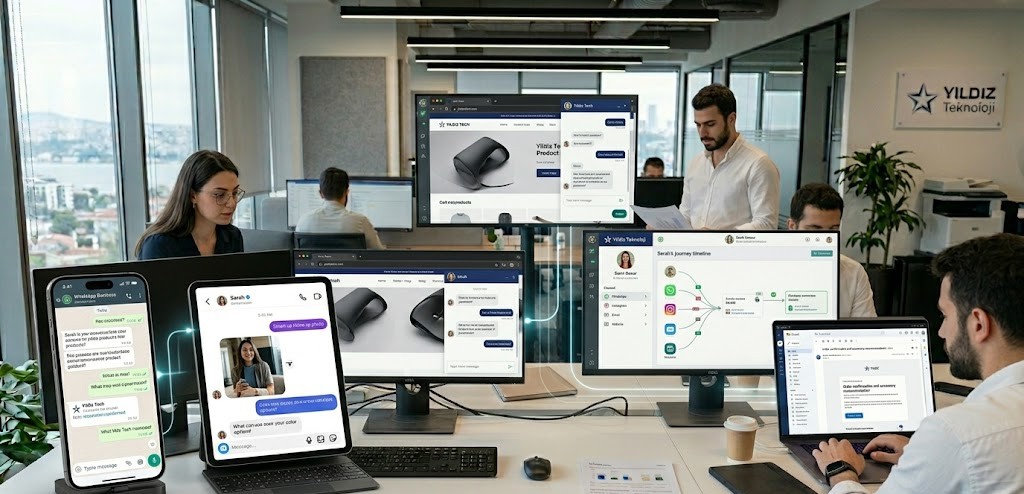
A connected WhatsApp chatbot Turkey setup can link these touchpoints. Website chat can capture the first question. WhatsApp can continue the conversation. CRM can store the details. Email can nurture the lead after the chat.
This is where omnichannel customer experience becomes practical: every channel works together, and every conversation has a clear purpose.
Features Turkish Businesses Should Prioritise
The right chatbot features depend on the business model. A clinic needs booking flows. An e-commerce brand needs product guidance. A B2B exporter needs lead qualification. A hotel needs availability and guest questions.
Most Turkish businesses should prioritise:
- Website chat
- WhatsApp connection
- Instagram or Messenger routing
- Turkish and English language flows
- Lead capture forms
- Booking or call scheduling
- CRM connection
- Human handoff
- Analytics dashboard
- Approved knowledge base
- Brand voice rules
- Mobile-friendly chat design
- Clear consent wording
- Secure data handling
Multilingual communication for Turkish and English buyers
A multilingual chatbot should do more than translate words. It should sound natural in each language.
A Turkish user may want direct guidance in Turkish. A UK buyer may expect clear English, local phrasing, and a more detailed trust journey. The chatbot should handle both with care.
The tone should feel friendly, calm, and professional across the website, ads, social content, and email follow-up.
CRM, analytics and privacy-by-design
A CRM chatbot integration turns conversations into structured data. Each lead, booking, and enquiry can enter the right pipeline. This creates better sales tracking and cleaner reporting.
A chatbot should also follow privacy-by-design. It should collect the details it needs, explain how data will be used, and keep the process clear. This matters for Turkish companies working with local, UK, and global users.
For performance, the analytics should show chat volume, lead quality, booking rate, handoff rate, response time, and assisted revenue.
How to Build a Chatbot Strategy With Pella Global
A chatbot performs best when it sits inside a wider growth system. That system includes content, SEO, Digital PR, paid media, UX, CRM, and software.
Pella Global already works across these connected areas. The team can shape a chatbot journey that fits the brand, website, and sales process. This is where digital marketing strategy and software development work together. The chatbot should feel like a natural part of the website.
Audit questions before launch
Before launch, ask simple questions:
- Which website pages bring the strongest enquiries?
- Which questions appear most often?
- Which channels matter most: website, WhatsApp, Instagram, or email?
- Which enquiries lead to revenue?
- Which answers need team approval?
- Which team should receive each enquiry type?
- Which metrics define success?
These questions guide the chatbot structure. They also keep the project focused on real business goals.
Content, automation, UX, SEO, and Digital PR alignment
A chatbot can only be as strong as the journey around it. The website should load fast. The content should answer buyer questions. The CTA should feel clear. The CRM should capture the right details.
This is why website chatbot planning should connect with technical SEO, content marketing, UX/UI, Digital PR, and brand positioning.
When everything works together, the chatbot supports more than one conversation. It supports visibility, trust, and measurable growth.
How to Measure Chatbot Performance
A chatbot should be measured like any other growth channel. The goal is to see how it supports leads, support quality, and sales.
Useful metrics include:
- Lead conversion rate
- Qualified lead rate
- Appointment bookings
- Response speed
- Human handoff rate
- Ticket creation rate
- Assisted revenue
- Repeat enquiry rate
- Customer feedback score
- CRM completion rate
These numbers show how the chatbot performs across the full journey. For AEO and SEO, repeated questions can become new FAQs, landing pages, or blog sections.
Final Thoughts
AI chatbots are becoming part of daily business communication. For Turkish companies, they can support website visitors, WhatsApp users, social media leads, and global buyers from one connected system.
The best results come from clear content, strong UX, good CRM setup, and a brand voice that feels human. For brands targeting the UK and global markets, the English journey should feel simple, warm, and trustworthy.
At Pella Global, every chatbot strategy can support stronger visibility, better conversations, and measurable growth through AI chatbots for Turkish businesses.
FAQs on AI Chatbots for Turkish Businesses
1. What is the best AI chatbot for a Turkish business?
The best option depends on your channels, CRM setup, sales process, and language needs. A small company may start with website chat and WhatsApp, while a larger brand may need deeper CRM, e-commerce, and ticketing connections.
2. Can AI chatbots capture leads?
Yes. Chatbot automation can ask qualifying questions, collect contact details, book calls, and route enquiries to the right team. This makes lead capture faster and easier to measure.
3. Do AI chatbots work in Turkish and English?
Yes. A strong multilingual chatbot can guide Turkish users and English-speaking buyers in a natural tone. The best results come from approved content, local context, and clear brand voice rules.
4. Can chatbots improve customer support?
Yes. A customer support chatbot can answer frequent questions, guide users through simple tasks, and create a route to a team member when needed. This keeps the experience smooth across website chat, WhatsApp, and social channels.
5. Are AI chatbots useful for sales?
Yes. An AI sales chatbot can guide product choices, explain packages, invite bookings, and support the team with better lead context. For e-commerce, service brands, and B2B companies, AI chatbots for Turkish businesses can turn more conversations into sales.
