


A buyer asks ChatGPT about your company. The answer gives an old address, places your brand in the wrong sector, or links it with another business. That answer may become the buyer’s first impression. Turkish companies can correct false information in ChatGPT by reporting the response, tracing its sources, updating core brand facts, and building stronger proof across the web.
The same approach applies when Google creates an inaccurate AI summary. A report can flag the answer. A wider correction strategy gives search systems clearer material to use next time.
What Happens When AI Gets Your Brand Wrong?
AI answers can shape perception before a website visit
People now ask AI tools who owns a company, what it sells, and where it operates. An inaccurate answer can shape the brand before the buyer reaches the official website.
This makes AI brand reputation management part of modern brand strategy. The link between AI hallucinations and brand reputation is simple: confident wording can make a loosely sourced claim feel settled.
False details can travel across the buyer journey
A directory may list an old office. A copied profile may use a former trading name. AI systems can combine these details into one confident answer.
That answer may shape an article, shortlist, or internal report. This is why false brand information in AI search deserves a response built around current, consistent facts.
Why ChatGPT and Google AI Search Get Brand Information Wrong
Conflicting information across websites and directories
AI tools may find one company description on the official site, another on LinkedIn, and a third on a trade directory. The system weighs these sources and forms an answer.
Older third-party pages may carry strong links, wide reach, or a long history online.
Old pages and dated media coverage
Search systems can surface pages long after a company moves office, enters a new market, updates its leadership, or retires a product.
Dated pages can influence an answer when newer material carries less detail. This explains searches such as ChatGPT business information wrong after an answer reflects a former version of the company.
Similar business names and entity mix-ups
Entity mix-ups can happen when brands share names, initials, sectors, or locations. AI systems may combine details from separate businesses. Clear legal names, locations, and official profile links make each entity easier to separate.
Limited English information about a Turkish company
A Turkish website may carry rich local detail, while the English version contains a short translation. Global AI tools then have less English material to read.
This creates language drift. AI may fill that space with external material from an older or narrower angle.
Crawl, indexing, and source access
AI search depends on accessible pages. OpenAI uses OAI-SearchBot to surface websites in ChatGPT Search. Google relies on publicly accessible, crawlable, and indexable pages for its search experiences.
Blocked pages and image-only facts reduce clarity. Strong SEO solutions create a clean path to current information.
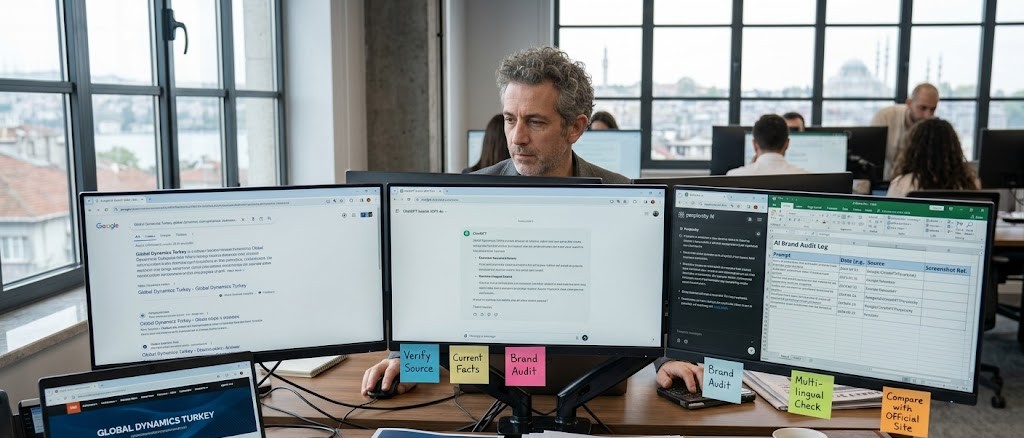
Start With an AI Brand Accuracy Audit
Test branded and buyer-intent prompts
An AI visibility audit should begin with real questions. Test prompts such as:
- What does [brand] do?
- Where is [brand] based?
- Who founded [brand]?
- Which markets does [brand] serve?
- Is [brand] linked with [similar company]?
Run the same questions in ChatGPT, Google AI Search, Gemini, and Perplexity. Small wording changes can produce different answers, so test several natural versions.
Record the answer, date, market, and platform
Record the exact prompt, answer, date, platform, language, country, and visible sources. Add screenshots because AI answers can change.
This creates a stable record.
Inspect every cited source
Open every citation in ChatGPT Search and every page shown beside a Google AI summary. Classify each page as current, dated, owned, third-party, or connected to another company.
This source map shows where correction work should begin.
Build a verified brand fact sheet
Create one approved document with the legal name, trading name, leadership, locations, solutions, sectors, markets, contact details, website, and official profiles.
This brand source of truth guides writers, developers, PR teams, and directory managers. Review it after each major company change.
Use a Four-Layer Brand Correction Strategy
A strong correction process works across four layers.
| Layer | Main action | Main aim |
| Response | Report the inaccurate answer | Flag the current output |
| Source | Update cited and influential pages | Replace dated facts |
| Entity | Align names, schema, profiles, and locations | Clarify identity |
| Authority | Earn trusted third-party confirmation | Reinforce the current story |
Stopping at the response layer leaves the same web evidence active. The deeper layers create a stronger base for future answers.
How to Correct False Information in ChatGPT
Report the inaccurate response
OpenAI allows users to select the thumbs-down icon and share feedback. Legal or safety matters can follow the reporting route shown in the feedback flow.
State the exact claim, the accurate fact, and the official page that confirms it.
Identify whether ChatGPT used web search
A searched answer may include inline citations or a Sources panel. Open those links first.
A response with no citations may reflect model training rather than a fresh search. Wider source alignment then becomes central.
Correct the pages ChatGPT cites
Update the homepage, About page, location pages, leadership pages, solution pages, and contact details.
Then contact owners of external pages with dated facts. Share the current wording and an official verification link. Each source can keep its style while core facts remain aligned.
Make current content accessible to OAI-SearchBot
Review robots.txt rules and server controls. A site that blocks OAI-SearchBot loses eligibility to appear as a source in ChatGPT Search answers, although a navigational link may remain.
Authority, relevance, and source quality still shape selection.
Use the privacy route for eligible personal information
OpenAI has a privacy request route for eligible personal information about a natural person, such as a founder or director. Corporate facts follow a wider path through feedback, source updates, and clearer web evidence.
How to Correct Inaccurate Information in Google AI Search
Submit detailed AI Overview feedback
Google allows users to rate an AI Overview with the thumbs-down control and add detail. Include the query, inaccurate sentence, accurate wording, and supporting source.
For Google AI Overview incorrect information, precision gives Google useful context.
Update the Google Business Profile
Review the business name, category, address, phone number, website, description, and social links. Verified owners can edit these fields through Google Search or Maps.
This matters for local brands and businesses with several Turkish locations.
Claim and review the Knowledge Panel
An authorised representative may claim an eligible Knowledge Panel and suggest updates with supporting links.
A Google Knowledge Panel correction works best when the official website, business profile, social profiles, and trusted sources agree.
Correct the cited source pages
To correct Google AI Overview content, inspect the pages attached to the summary. Update owned pages first, then approach external publishers where a source carries dated or mixed information.
Broad wording gives search systems a loose picture. Clear details about products, sectors, locations, and markets create a sharper one.
Request recrawling through Search Console
After updating an owned page, use Google Search Console to request indexing for that URL. This alerts Google to revisit the page.
Keep the page live, accessible, internally linked, and consistent with the rest of the site while Google processes the change.
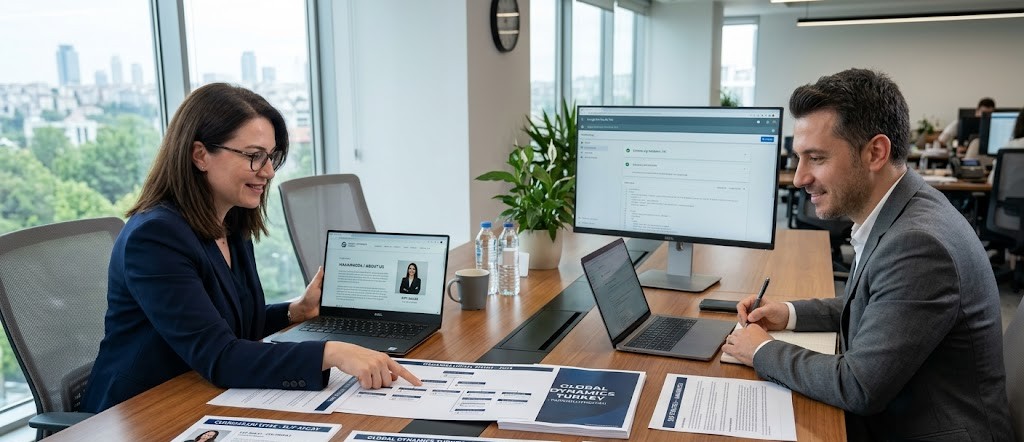
Create One Clear Source of Truth for Turkish and Global Audiences
Align Turkish and English brand descriptions
Turkish and English sites can speak to different audiences while keeping the same identity. Use the same legal name, trading name, leadership, locations, and official profiles.
English pages should reflect UK search terms, buyer questions, and sector language.
Standardise names, categories, and locations
Choose one main company name and one approved short form. Use them across the website, Google Business Profile, LinkedIn, directories, and partner pages.
Keep categories and locations consistent as well.
Strengthen the homepage and About page
The homepage should state what the company does, who it works with, and where it operates. The About page can add history, leadership, market experience, and official facts.
Keep both pages current and specific.
Add Organisation and LocalBusiness structured data
Organisation schema can connect the brand name, logo, website, contact details, and official profiles. LocalBusiness schema can clarify a physical office, address, opening details, and area served.
This form of structured data for Turkish businesses supports classification and rich search features. It also supports generative engine optimisation and answer engine optimisation by making key facts easier to retrieve.
Connect official profiles and entity relationships
Use sameAs links to connect trusted official profiles. Keep author pages, leadership bios, office pages, and company details linked through a clear internal structure.
Pella Global’s guide to Knowledge Graph optimisation for Turkish brands explains how connected facts and trusted mentions build entity clarity and stronger entity optimisation.

Use Digital PR to Reinforce Accurate Brand Information
Correct external profiles and media pages
AI systems also read news pages, interviews, directories, awards, podcasts, and partner pages.
A joined AI search visibility strategy should review these sources first when they rank for the brand name or appear in AI citations.
Earn credible English-language coverage
Turkish companies targeting the UK and global markets need strong English proof through interviews, commentary, research, and market insight.
This is where Digital PR Turkey and online reputation management Turkey work together. Digital PR solutions can strengthen trusted coverage and keep the brand story current.
Publish expert commentary around the brand’s sector
Publish expert views, practical guides, original research, case studies, and named commentary. This gives the brand a clear relationship with its sector, audience, and expertise.
Measure Whether AI Understands the Brand More Accurately
Track brand accuracy across repeated prompts
Repeat the same prompt set each month. Record brand mentions, descriptions, and sources.
This reveals answer volatility. Stable accuracy across several prompts and platforms is the stronger result.
Monitor citations and source quality
Track whether official pages and trusted media begin to replace dated directories or unrelated sources.
Group brand misinformation in AI search by identity, leadership, location, ownership, solutions, sector, and market reach.
Measure sentiment and AI share of voice
Compare answer tone and accuracy with direct competitors. Track mentions, citations, shortlist appearances, and source quality.
Google introduced dedicated generative AI performance reporting in Search Console in 2026. Use it beside prompt tracking, branded search, engagement, and conversions.
Recheck after major company updates
Run a fresh audit after a rebrand, office move, leadership update, acquisition, market launch, or major solution change. Update the fact sheet first, then work through owned pages, profiles, schema, and external sources.
Frequently Asked Questions
Can a business directly edit a ChatGPT answer?
A business has no direct edit panel for a standard ChatGPT response. It can submit feedback, report eligible content, correct source pages, and strengthen current brand evidence across the web.
How long can an AI correction take?
Timing varies by platform, source, crawl cycle, and query. Track the same prompts over several weeks and record changes in answers, citations, and source quality.
Does structured data guarantee accurate AI answers?
Structured data creates clearer machine-readable facts and supports search understanding. Selection and wording still depend on content quality, authority, relevance, and external confirmation.
Can Google Business Profile updates influence AI Search?
Accurate profile details can strengthen Google’s understanding of a local business. The wider brand picture should also align across the website, Knowledge Panel, directories, schema, and trusted media.
What should a Turkish business do when AI combines it with another company?
Clarify the legal name, trading name, location, category, leadership, and official profiles across every key source. Then report the inaccurate answer and build stronger entity links that separate the two businesses.
Conclusion: Accurate AI Visibility Begins With Clear Brand Evidence
Reporting an inaccurate answer is the first action. Lasting correction comes from current source pages, clear entity signals, aligned Turkish and English content, and credible third-party confirmation.
A strong strategy joins technical SEO, Digital PR, content, structured data, and regular monitoring. It gives people and search systems the same clear account of who the brand is.
At Pella Global, we create connected strategies for Turkish businesses seeking stronger visibility, authority, and trust across global search. The right foundation makes it easier to correct false information in ChatGPT.
