


The question “Is a website or social media more important for brands?” actually starts from the wrong place. The right question is: What is your goal, what is your industry, and how does your sales model work?
A website and social media are not competing channels, they are separate channels with different roles. One is the digital asset that the brand owns, and the other is the distribution space that provides reach and visibility.
In this post, we will discuss:
- The real functions of a website and social media,
- Which should take priority in which situation,
- And a practical decision matrix with clear examples to help you make the right decision for your brand.
Let’s move beyond the “either/or” dilemma and see how they work together.
Short Answer: “A Website is Your Asset, Social Media is Your Rental Space”
The simplest but most accurate summary on this subject is:
A website belongs to you, but social media does not.
Social media is powerful but temporary. A website is slow but permanent.
The real difference lies in who is in control and where the value accumulates.
What does a website (owned media) provide?
A website is the digital hub of a brand. All traffic, content, and campaigns ultimately need to be directed here.
What a website provides:
- Complete control: Content, design, offers, CTAs, and user journey are entirely yours.
- Data ownership: Visitor behavior, conversions, CRM, and measurement remain within your system.
- Conversion-oriented structure: Clear actions can be taken, such as forms, appointments, offers, and sales.
- Trust building: References, case studies, certifications, and a detailed explanation area.
Sustainable demand with SEO: Organic traffic that continues even after ads are removed.
In short, a website is the digital memory and sales engine of a brand.
What does social media (rented media) provide?
Social media is the brand’s microphone. It speaks quickly, spreads quickly, but is not permanent.
Social media’s strengths:
- Fast reach: Reaching a large number of people in a short time.
- Community and interaction: Building connections through comments, DMs, and shares.
- Brand perception: Tone, stance, visual language, and storytelling.
- Content distribution: Driving traffic to blogs, campaigns, and landing pages.
However, it’s important to remember: Algorithms can change, reach can decrease, and accounts can be closed.
The overall framework of these two channels and how they should be positioned together forms the basis of a digital marketing agency’s approach.
When is a Website More Important?
In some business models, a website is not just “nice to have,” it’s essential.
Sales/conversion-focused brands
If your goal is:
- Lead generation
- Scheduling appointments
- Offering proposals
- Making online sales
the website is the main channel.
Social media is only a supporting traffic source here.
The real decision is made on the website, and the real conversion happens there.
At this point, a conversion-focused website design should be approached with a web design agency perspective.
Industries Where Buyers Need Time and Trust to Decide
In long decision-making industries, users don’t make purchases after seeing a single post.
Especially:
- B2B services
- High-priced services
- Healthcare
- Education
- Consulting
Users want details, compare, and look for references.
This layer of trust is provided by a well designed website, not social media.
Brands that want sustainable growth with SEO
If you want demand to come in every month without advertising, a website is essential.
An effective SEO structure is built on:
- Question-based content (blogs, guides, explanatory pages)
- Service pages (clear offer + CTA)
- Local SEO (especially for service businesses)
This system:
Transforms into sustainable growth with SEO agency servcie support, and into scalable demand with a content marketing agency approach.
When is Social Media More Important?
In some cases, social media is the channel that initiates the game.
Brands focused on discovery and brand visibility
If the brand:
- Is newly established
- Is launching a new product
- Is entering a new market
Users need to discover you.
For products and services with low decision barriers, social media is the first point of contact.
Business models that grow through communication
Social media is more dominant in these models:
- Personal brands
- Influencer-supported sales structures
- Community-based brands
Here, relationships, content, and engagement come before sales. Social media is not a “channel,” but part of the business model.
This structure is usually made sustainable with professional social media management.
Need for quick campaign and demand gathering
When time is limited:
- Launch
- Discount
- Event announcement
- Short-term goals
Social media and advertising are the fastest way.
However, the critical detail here is:
The traffic must necessarily flow to a landing page or website.
These kinds of short-term performance needs are usually managed with a digital advertising agency setup.
The Biggest Misconception: Not “Either/Or,” but “Working Together”
Many brands still view their website and social media as alternatives. However, the correct approach is to treat these two channels not as opposing forces, but as parts of the same system.
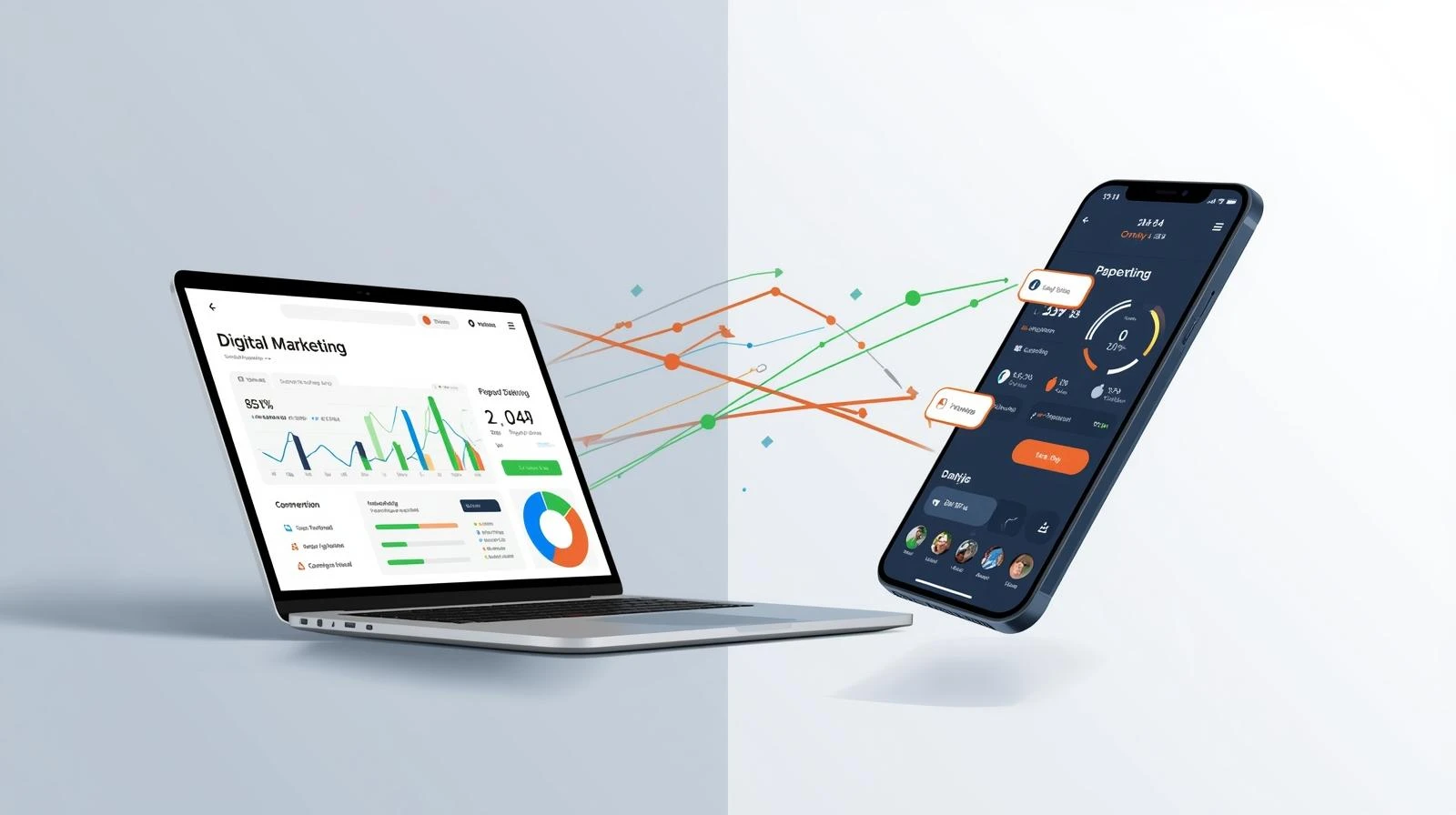
The Right Model: Social Media – Traffic/Engagement – Website – Conversion
The healthiest digital marketing structure works with a funnel logic:
- Social Media: Upper and Middle Funnel
(Discovery, Interest, Engagement, Reminders) - Website: Lower Funnel
(Persuasion, Trust, Offer, Conversion)
Social media brings people in, the website prompts decisions. When these two roles are reversed, the system becomes inefficient.
Social media cannot replace a website because…
No matter how powerful social media is, you don’t have control:
- Algorithms change, reach decreases
- A format that works today may be ineffective tomorrow
- Accounts may be suspended or closed
- Visitor and customer data does not belong to you
Therefore, social media alone cannot be a sales and growth infrastructure.
A website cannot replace social media because…
A website, by its nature, is not a distribution channel:
- Content doesn’t spread on its own.
- Discovery and visibility are limited.
- Reaching new audiences takes time.
Therefore, a website grows slowly without social media. It needs social channels for distribution and attention.
Website vs. Social Media Decision Matrix
The following quick test clarifies which channel should take priority.
6-question quick decision test
- Is your priority sales or visibility?
- Is the customer decision-making time short or long?
- Is your target customer local (local SEO) or national/international?
- Is your offer clear? (package, price, strong CTA)
- Do you have the resources to produce regular content?
- Is the measurement and CRM infrastructure ready?
Your answers to these questions will already indicate the channel priority.
Interpreting Results
Sales + long decision-making time + need for trust: Website priority
Discovery + fast campaign + short-term goal: Social media priority
(But must be supported by a conversion page on the web)
In summary we can say:
Priorities may change, but a structure without a website is not sustainable.
The Most Appropriate Structure (Scenarios) According to the Goal
The ideal balance is different in every business model. Below are the three most common scenarios.
Scenario 1: Service business (appointment/offer)
Website:
- Landing page
- References and social proof
- Form, search button or WhatsApp
Social media:
- Trust-building content
- Before/after, sample work
- Clear link to the web
Goal: Build trust on social media, get conversions on the web.
Scenario 2: E-commerce
Website:
- Product page optimization
- Clarity of return, shipping, and delivery processes
- Simple shopping cart and payment flow
Social media:
- UGC (user content)
- Influencer collaborations
- Short videos and remarketing
Goal: Create demand on social media, close sales online.
Scenario 3: B2B brand (lead/pipeline)
Website:
- Case studies
- Whitepaper, guide, demo
- Offer and contact forms
Social media:
- Thought leadership content
- Event and webinar announcements
- Remarketing
Goal: Long-term trust + qualified lead generation.
Measurement: Which Channel Really Works?
The only true answer to the question “Which one is better?” is data.
Minimum Setup
The most basic measurement infrastructure should include:
- GA4 setup
- Conversion events (form, search, WhatsApp, purchase)
- UTM standard (clearly identify where each traffic is coming from)
Any interpretation made without these is just an estimate.
KPI Examples
For websites:
- Conversion rate
- Lead quality
- Page-based performance
- Traffic: conversion rate
For social media:
- Website referral traffic
- Clicks and sign-ups/leads
- Remarketing contribution
The correct interpretation and meaningful reporting of these KPIs are generally addressed with a growth marketing & insight approach.
7 Most Common Mistakes
The mistakes brands make in this area generally stem from incorrect expectations, not the channel.
- Expecting direct sales from social media while leaving the website empty
If there is interest but no conversion, the problem is not the channel, but the infrastructure. - Using the website only as a “corporate brochure”
No offers, no CTAs, no referrals: no conversions. Offer and CTA ambiguity - Saying “contact us” is often not enough
The user must clearly see what they will receive. - Spending budget without measurement
Spending without knowing which channel is working is blind progress. - Content inconsistency (brand voice)
If what is said on social media differs from what is said on the web, trust is lost. - Focusing only on follower count
Follower increase ≠ business result. Its impact on traffic, leads, and sales should be measured. - Relying on a single channel
Connecting the entire system to social media or only the web increases risk.
Conclusion: The real question isn’t “Which is more important?”, it’s “How should they work together?”
The question of whether a website or social media is more important is meaningless on its own. The real difference lies in prioritizing correctly according to the target audience, industry, and sales model, and structuring the collaboration effectively.
- Social media makes the brand visible.
- A website converts that interest into business results.
One is incomplete without the other. Growth slows down without social media, and conversions are wasted without a website.
Winning brands are not those that choose between channels, but those that integrate channels into the same system.
