


AI-powered ad management is changing how brands plan, run and improve paid campaigns on Google and Meta. Today, a strong ad setup needs more than a budget and a few audience choices. It needs clear goals, clean tracking, strong creativity, useful data and a team that can guide the system with purpose.
Google and Meta now use AI across many parts of advertising. The platforms can read signals, adjust bids, test creative, match ads with people and move spend towards stronger results.
For UK and global brands, this matters. People search, scroll, compare and buy across many channels. The real win comes when every part of the campaign works together.
What Is AI-Powered Ad Management?
AI-powered ad management means using advertising platforms and machine learning tools to plan, launch, optimise and measure paid campaigns. It covers bidding, budget movement, audience matching, creative testing and reporting.
It sounds technical. In practice, it is simple. The ad system learns from data and makes faster choices.
From manual media buying to intelligent campaign decisions
Before AI became central to paid ads, campaign managers adjusted bids, edited audiences and tested messages by hand.
Now, AI can read signals such as device, time, location, intent, creative response and conversion actions.
Why Google and Meta now rely on automation
Google and Meta handle huge amounts of user behaviour and ad data. Manual control alone can move slowly in that environment.
Automation allows each platform to match ads with better moments. That is why Google Ads AI and Meta Ads management now depend so much on machine learning.
How AI supports targeting, bidding, creative and reporting
AI supports paid media in four main ways:
| Area | What AI does |
| Targeting | Reads signals and finds likely audiences |
| Bidding | Adjusts bids based on goals and value |
| Creative | Tests text, image and video variations |
| Reporting | Spots patterns for better decisions |
This is where paid advertising automation becomes useful. It removes slow manual steps and gives campaign teams more room to focus on strategy.

Why Smart Campaigns Matter for UK and Global Brands
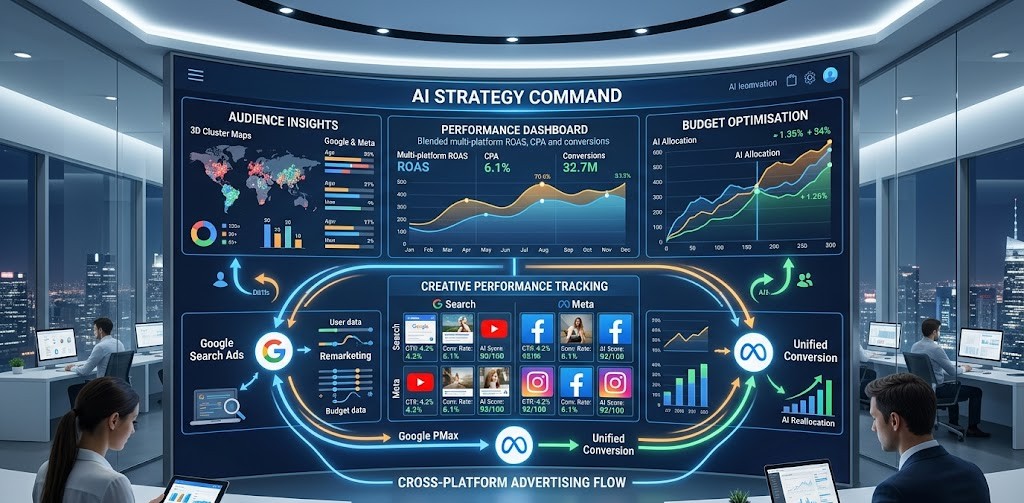
Smart campaigns matter because buyers move quickly. A person may see a Meta ad, search on Google and return through a retargeting ad later.
AI connects these moments and guides spending towards the best available opportunity.
Faster campaign learning across digital channels
AI learns through signals. Every click, view, form fill, sale and audience action teaches the system more.
This makes AI advertising campaigns useful for brands that want faster learning. The more accurate the setup, the better the system can understand what success looks like.
Stronger audience matching through platform signals
Audience matching has moved beyond age, gender and basic interests. Meta can use engagement behaviour. Google can use search intent and conversion signals.
This creates stronger audience discovery when first-party data and clear audience direction are in place.
Smarter budget movement across campaigns and ad sets
AI can move budgets based on what is working. Meta uses central campaign budgets across ad sets. Google uses Smart Bidding and campaign-level goals.
This is the heart of campaign budget optimisation.
Official Google AI Ad Features Every Brand Should Know
Google has several AI-led ad tools. Each one serves a slightly different purpose.
Google Smart Campaigns
Google Smart Campaigns are built for a simpler setup. A brand chooses a budget, location and keyword themes. Google then shows ads across Search, Maps, YouTube and partner sites.
This gives smaller teams a lighter entry point into smart campaigns.
Performance Max
Google Performance Max is a goal-based campaign type. It can run across Google inventory from one campaign, including Search, YouTube, Display, Discover, Gmail and Maps.
The campaign relies on conversion goals, creative assets, audience signals and tracking. Strong inputs lead to stronger learning.
Smart Bidding
Smart Bidding uses Google AI to adjust bids for conversions or conversion value. It can use strategies like Target CPA, Target ROAS, Maximise conversions and Maximise conversion value.
This is useful when the brand has clear conversion goals and enough data for the system to learn.
AI Max for Search campaigns
AI Max for Search campaigns adds AI features to existing Search campaigns. It can expand reach, tailor creativity and guide users to stronger landing pages.
It is an optimisation layer, rather than a new campaign type. This makes it useful for brands that already run Search ads and want broader coverage.
AI Max for Shopping, Travel, and AI Brief
Google is also expanding AI Max into shopping and travel ad formats. AI Brief adds another layer by letting advertisers guide messaging and audience direction in plain language.
This shows where search advertising is going. The platform is moving from fixed keyword control to guided AI systems.

Official Meta AI Ad Features Every Brand Should Know
Meta has built its AI ad tools under the Advantage+ family, across Facebook, Instagram and other Meta placements.
Meta Advantage+
Meta Advantage+ is Meta’s AI suite for campaign performance. It can optimise audiences, placements, creative and budgets in real time.
Advantage+ Audience
Advantage+ Audience uses Meta AI to find people who are likely to act. The advertiser can still give direction, such as location, age or audience suggestions.
Advantage+ Placements
Advantage+ Placements allows Meta to show ads across different placements. These can include Feed, Stories, Reels and other Meta spaces.
Each placement behaves differently, so AI can test where the ad has the best chance to perform.
Advantage+ Campaign Budget
Advantage+ Campaign Budget uses one central campaign budget. Meta then distributes spend across ad sets in real time.
This supports better campaign budget optimisation because spend can move with performance signals.
Advantage+ Creative
Advantage+ Creative uses AI to improve creative versions. It can adjust images and videos to match the formats audiences are more likely to engage with.
This supports creative testing because one idea can become several variations for different placements.
Advantage+ Sales, Leads and App Campaigns
Meta also has Advantage+ Campaign types for sales, leads and apps. These use AI across bidding, audiences and placements.
For e-commerce, lead generation and app growth, these tools can improve learning speed.
Google Ads AI vs Meta Ads AI: Where Each Platform Performs Best
Google and Meta both use AI, although people use the platforms in different ways.
Google for search intent and demand capture
Google works well when people are already searching. A user may type “best digital marketing agency” or “Google Ads agency for e-commerce”.
That kind of intent assists Google in capturing demand that already exists.
Meta for discovery, attention and social engagement
Meta works well for discovery. People may scroll Instagram or Facebook before they know they need a brand.
Strong visuals, hooks and messaging can create interest. This makes Meta useful for awareness and social engagement.
Why brands gain more when both platforms work together
A strong digital advertising strategy often uses both. Meta can introduce the brand. Google can capture the search that follows.
Together, they create a fuller journey. This is where Google and Meta campaigns can support each other rather than compete.
How AI-Powered Ad Management Works in Practice
AI performs best when the setup is clear.
Conversion goals and tracking setup
The first step is choosing the right conversion goal. This could be a purchase, lead form, call, booking or website action.
Clear conversion tracking tells the platform what matters. It also keeps reports tied to real business activity.
Audience signals and first-party data
Audience signals guide the system. These may include website visitors, customer lists, search themes or past buyer behaviour.
Strong audience signals make AI learning faster. They give the platform a better starting point.
Creative assets, testing and message variation
Creative still matters. AI can test headlines, descriptions, images and videos, yet it needs strong ideas to work with.
A useful creative set may include:
- Clear headlines
- Short benefit-led copy
- Brand visuals
- Video in multiple formats
- Social proof where suitable
This creates better creative testing across placements.
Budget optimisation and bidding rhythm
Budget rhythm matters. Heavy changes can affect learning. A steady setup gives AI time to read the market.
Smart bidding and central budgets can guide spending. This keeps performance marketing automation focused on growth.
Reporting, learning and campaign refinement
Reports should go beyond clicks. A useful report shows conversions, cost per result, audience response, creative performance and landing page behaviour.
This turns automation into insight for the next campaign cycle.
Why Human Strategy Still Shapes AI Campaign Performance
AI can manage many campaign actions. Human strategy gives them direction.
Brand voice still needs direction
AI can test ad copy, yet brand voice must come from the business. The message needs to feel clear, natural and aligned with the audience.
Landing pages shape conversion quality
An ad can bring traffic. The landing page turns that traffic into action.
A strong page should be fast, clear and easy to use. It should match the ad message and guide the visitor towards the next step.
Data quality guides the algorithm
AI learns from the data it receives. Clean tracking, clear goals and useful audience inputs create better learning.
A good strategy keeps the system focused on meaningful results.
Reporting turns automation into business insight
Numbers need context. A campaign can have many clicks and still need better lead quality or stronger sales action.
Human review connects platform data with real business goals.
How Pella Global Builds Smarter Google and Meta Campaigns
Pella Global’s approach fits this new ad landscape through strategy, clarity and measurable outcomes.
Strategic planning before campaign launch
Before launch, every campaign needs a clear structure. This includes goals, audiences, budget, creative direction, tracking and reporting.
Pella Global’s digital advertising approach already focuses on audience, market position, smart budgeting, targeting and performance tracking.
AI-enhanced marketing with brand clarity
AI works best when the message is clear. This is why AI-enhanced marketing should include brand tone, audience insight and content direction.
The same thinking applies to search visibility. Pella Global’s guide on AI search engines shows why clear, structured content matters for modern discovery.
Creative, audience and budget alignment
Smart campaigns need alignment. Creativity should match the audience. The budget should match the goal. Tracking should match the business outcome.
This is also where SEO supports paid media. Strong search visibility and paid campaigns can work together to build trust and improve online presence.
Measurable reporting for long-term growth
The best reports are easy to read and useful. They show what changed, what improved and what the next step should be.
This keeps AI-powered digital marketing focused on clear growth.
Final Thoughts on AI-Powered Ad Management
Smart campaigns are now a core part of paid advertising. Google and Meta are moving deeper into automation, AI-led bidding, broader audience matching and creative variation.
For brands, the goal is simple. Feed the system with good data, set clear goals, use strong creativity, and refine with a clear plan.
Smart campaigns need strategy, data and creative quality
AI needs direction. A strong strategy gives it that direction.
The strongest campaigns combine platform automation with human judgment. That mix supports better use of media spend.
The next phase of digital advertising belongs to guided automation
Guided automation is the new standard. Brands that use it well can move faster.
At Pella Global, digital growth is built through strategy, creativity, data and clear communication across every stage of the campaign journey.
FAQs on AI-Powered Ad Management
1. What is AI-powered ad management?
AI-powered ad management is the use of AI tools to plan, run, optimise and measure paid ads. It can support bidding, targeting, creative testing, budget movement and reporting.
2. Is Google Ads AI better than Meta Ads AI?
They work best for different goals. Google is strong for search intent, while Meta is strong for discovery, attention and social engagement.
3. What is the role of a digital marketing agency in AI ad campaigns?
A digital marketing agency guides the strategy behind the tools. The agency shapes the goals, creative direction, tracking setup, audience inputs and reporting so automation works with purpose.
4. Can smart campaigns improve ROI?
Smart campaigns can improve ROI when goals, tracking, budget and creative are well set up. The system needs clear signals to learn what actions matter most.
5. Why should brands use Google and Meta campaigns together?
Google can capture people who are already searching. Meta can introduce the brand to people through social content and visual storytelling. Together, they create a stronger path from discovery to action through AI-powered ad management.
