


A content refresh calendar gives Turkish businesses a simple way to keep website pages current, useful, and visible in 2026. Instead of treating older pages as finished work, brands can review them often, add new facts, match search intent, and guide readers to the next clear action.
What Is a Content Refresh Calendar?
A content refresh calendar is a planned schedule for reviewing and improving existing website content. It covers blog posts, landing pages, product pages, guides, FAQs, and brand pages.
How it differs from a standard content calendar
A standard calendar focuses on new posts. It answers, “What should we publish next?” An SEO content calendar goes further. It tracks keywords, intent, internal links, CTAs, and review dates.
Why existing content deserves a planned update cycle
Older content can carry strong authority. It may already rank, attract impressions, or bring leads. A smart content refresh strategy checks facts, examples, dates, headings, links, and calls to action.
Why Turkish Businesses Need a 2026 Content Refresh Calendar
Turkey has a strong digital audience. DataReportal recorded 77.5 million internet users in Turkey in late 2025. That means most buyers now research online before they call, book, compare, or buy.
Turkey’s fast-growing digital market and global audience opportunity
Turkish businesses often serve many groups at once. A clinic may speak to UK patients. A real estate firm may speak to global investors. An e-commerce brand may speak to Turkish buyers and overseas shoppers.
That mix makes content marketing in Turkey more strategic. Pages need local detail, clear English, simple proof, and a strong path to enquiry.
Why UK and international readers expect fresh, clear information
UK and global readers compare brands quickly. They want current dates, plain language, useful examples, and easy next steps.
For a Turkish company, English content should feel native to the reader. Use UK spelling. Explain local terms. Keep the page easy to scan.
How AI search changes content discovery
Search now happens across Google, AI assistants, and social search. This makes AI search visibility a core part of digital marketing in Turkey.
AI tools prefer pages with direct answers, tidy headings, fresh facts, and clear brand signals. Pella’s recent article on structured data for Turkish websites explains how clean page signals support search systems and AI tools.

The Core Elements of a Strong SEO Content Calendar
A strong SEO content calendar should feel easy to use. A simple spreadsheet can work well.
Target URL and current performance
Start with the page URL. Add clicks, impressions, average position, conversions, leads, or enquiries.
Primary keyword and search intent
Add one main keyword for each page. Then write the intent in plain English. This keeps the page focused and supports stronger content optimisation.
Topic cluster and internal link targets
Each page should belong to a cluster. A topic cluster may include a guide, a solution page, FAQs, a case study, and thought leadership.
Internal links create a clear route. For deeper planning, Pella’s SEO solutions connect keyword research, content structure, and technical search growth.
CTA, owner, status and review date
Every page needs one clear next action. Add an owner, stage, and review date. This keeps the calendar moving.
GA4 and Search Console metrics
Use Google Analytics 4 and Search Console to track clicks, impressions, leads, and key events.
How to Choose Which Pages to Refresh First
Start where a small update can create strong value.
Pages with strong impressions and lower clicks
These pages already appear in search. A sharper title, meta description, intro, or FAQ can lift clicks.
Pages tied to revenue, leads, bookings or enquiries
Give priority to pages that support sales. This may include solution pages, clinic pages, export pages, product categories, and contact-led landing pages.
Seasonal pages before demand peaks
Seasonal pages need early updates. Refresh Ramadan, travel, summer, education, Black Friday, and year-end content before the search peak.
Pages with old statistics, tools, screenshots or instructions
Any page with dated data needs a review. Update numbers, screenshots, tools, pricing notes, platform names, and process steps.
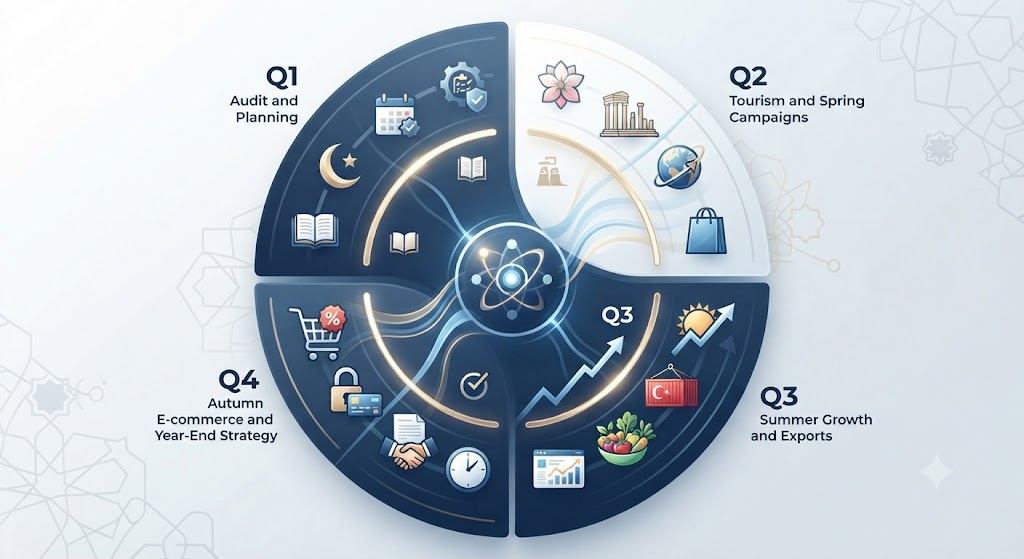
2026 Content Refresh Calendar for Turkish Businesses
Here is a simple yearly structure.
January to March: audit, planning and Ramadan season readiness
Use January for a full content audit. In February and March, prepare Ramadan content across retail, travel, food, finance, and hospitality.
April to June: spring campaigns, tourism, education and Eid planning
April is good for tourism, education, real estate, and family-led campaigns. May and June should cover Labour Day, Youth and Sports Day, Sacrifice Feast planning, and early summer travel.
July to September: summer travel, export visibility and Q3 reviews
Summer is strong for tourism, hospitality, property, medical travel, and retail. Use September for a Q3 content review.
October to December: Republic Day, Black Friday, year-end planning and 2027 preparation
October should include Republic Day content and early Q4 planning. November is key for e-commerce. Turkey’s Ministry of Trade reported 4.57 trillion TL in 2025 e-commerce volume. December can focus on year-end reports, 2027 planning pages, and refreshed case studies.
Turkey-Specific Dates to Add to the Calendar
Use dates as planning signals, then shape content around audience intent.
Ramadan and Ramadan Feast
In 2026, Ramadan begins in February, with Ramadan Feast dates around 20 to 22 March. Refresh related pages 6 to 8 weeks earlier.
National Sovereignty and Children’s Day
23 April is useful for family, education, events, retail, and civic content.
Labour and Solidarity Day
1 May can guide B2B, HR, employer brand, legal, events, and social content.
Commemoration of Atatürk, Youth and Sports Day
19 May works well for youth, sports, education, wellness, and community campaigns.
Sacrifice Feast
Sacrifice Feast falls in late May 2026. Retail, travel, food, gifting, and charity pages should be ready early.
Democracy and National Unity Day
15 July can guide civic, historical, and national content for brands where the context fits.
Victory Day
30 August can support national pride, campaigns, events, and tourism pages.
Republic Day
29 October is one of the strongest national dates. Refresh brand, culture, campaign, and PR content ahead of the period.
November e-commerce campaign season
November is a major e-commerce planning window. Refresh gift guides, category pages, delivery pages, return pages, and buying guides in September or October.
How Content Refresh Supports SEO, AI Search and Digital PR
A refresh can strengthen the whole digital footprint.
Fresh data and clearer answers for search engines
Search engines need clear content. Update facts, rewrite intros, answer direct questions, and improve headings. This supports search visibility.
Stronger citations for AI assistants
AI assistants look for content they can read, explain, and cite. Clear sections, exact answers, and current facts support AI search optimisation and long-term AI search visibility.
Better internal linking across topic clusters
A refreshed page should connect to related pages. Link guides to solution pages. Link solution pages back to thought leadership. This supports online visibility.
More consistent brand positioning across channels
A refresh is a good time to align tone, proof, CTAs, and page design. Strong brand positioning makes the same story appear across search, PR, email, and social media.
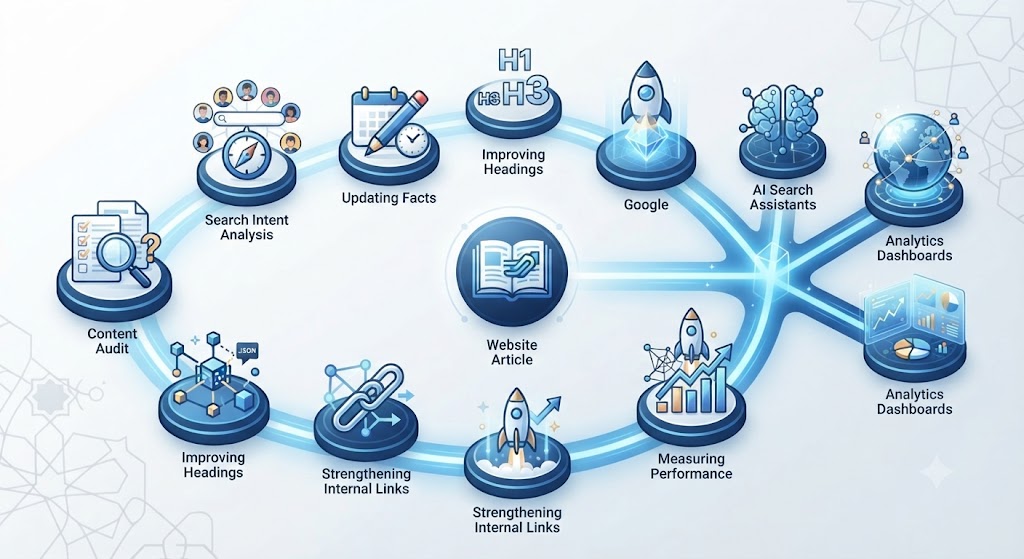
A Practical Content Refresh Workflow
Keep the workflow simple.
Step 1: Audit the current page
Check traffic, rankings, leads, links, dates, layout, and search results.
Step 2: Recheck search intent
Search intent changes. Review the SERP and ask what the reader expects now.
Step 3: Update data, examples and screenshots
Replace dated figures. Add fresh examples. Update screenshots and platform names.
Step 4: Improve headings and answer clarity
Use clear H2s and H3s. Add short answers under key questions. This supports AEO and featured snippets.
Step 5: Strengthen internal links and CTAs
Add useful internal links. Guide readers toward the next best action.
Step 6: Add structured data and dateModified
Use Article schema, FAQ schema where suitable, and accurate dateModified data after meaningful edits.
Step 7: Track results after publication
Review the page after 30, 60, and 90 days. Track clicks, impressions, leads, and assisted conversions.
Recommended Calendar Fields
A good calendar can be simple.
| Field | What to track |
| URL | Page that needs a refresh |
| Keyword | Main search phrase |
| Intent | Reader goal |
| Cluster | Related topic group |
| CTA | Next action |
| Owner | Person in charge |
| Review date | Next check |
| Metrics | Clicks, leads, enquiries |
Page title, URL and content type
Label the asset clearly. A blog, landing page, and product page need different actions.
Target keyword and secondary keywords
Use one main keyword and a few natural secondary phrases.
Intent, audience and funnel stage
Mark whether the page speaks to awareness, consideration, or decision.
Priority score and business value
Give high scores to pages that support leads, bookings, revenue, or brand authority.
Refresh action and owner
State the action. Assign one owner.
Publish date and next review date
Record the update date and the next review date.
Internal links, CTA and schema notes
Add link targets, CTA text, and structured data notes.
GA4 and Search Console metrics
Record baseline metrics before the refresh. Review again after the page settles.
How Often Should Turkish Businesses Refresh Content in 2026?
Frequency depends on value and pace.
Monthly checks for top revenue pages
Check money pages each month. These pages deserve close attention.
Quarterly checks for strategic SEO pages
Review key SEO guides every quarter. Add new questions, links, and examples.
Six-month checks for evergreen guides
Evergreen content can follow a six-month rhythm.
Annual checks for brand and company pages
Company pages, profile pages, and core trust pages should receive a yearly review.
Common Content Refresh Calendar Actions
A refresh can be small or deep.
Add recent data
Add current numbers, market notes, and fresh sources.
Rewrite the introduction around current intent
Make the opening match what people search for now.
Add FAQs
FAQs make content easier for people and answer engines.
Improve examples for UK and global readers
Use examples that feel natural to UK and global audiences.
Add internal links to Pella solutions
Link refreshed content to relevant Pella pages. The content marketing solutions page is a natural fit when the article speaks about planning, copy, and creative content.
Update schema and page dates after meaningful edits
Add accurate dateModified data when the page receives a true refresh.
Repurpose the refreshed article into LinkedIn, email and social content
A refreshed blog can become a LinkedIn post, email topic, or short video script. This makes social media management, email, and PR work from the same source.
How Pella Global Supports Strategic Content Growth
A content calendar works best when SEO, content, PR, and analytics sit together.
SEO and content planning
Pella can guide keyword mapping, search intent, page structure, and update priorities.
Digital PR and authority building
Digital PR brings trusted mentions, expert features, and wider brand authority. It also supports reputation management and AI search trust.
AI search visibility
AI search needs clear pages, structured facts, and strong public signals. Refreshing content keeps those signals current.
Analytics and performance tracking
Growth needs measurement. Performance tracking shows which updates create traffic, leads, and enquiries.
Brand positioning across Turkey and global markets
For Turkish brands, English content should carry confidence for the UK market and global buyers.
FAQs About Content Refresh Calendars
What is a content refresh calendar?
A content refresh calendar is a schedule for updating existing website pages. It covers keywords, search intent, CTAs, internal links, owners, metrics, and review dates.
How often should a Turkish business refresh website content?
High-value pages can be reviewed monthly or quarterly. Evergreen guides can follow a six-month cycle, while brand pages can receive one full review each year.
What should a content refresh calendar include?
It should include the URL, main keyword, secondary keywords, audience, intent, owner, action, CTA, internal links, schema notes, and performance data. This makes the calendar useful for SEO, content, and sales teams.
Can refreshed content improve AI search visibility?
Yes. Fresh facts, simple answers, clear headings, strong internal links, and structured data make content easier for AI systems to understand. This supports AI search visibility across answer engines.
Which pages should enter the calendar first?
Start with pages that already have impressions, traffic, leads, or clear business value. These pages often create the fastest return from a focused refresh.
How far ahead should businesses plan content updates?
Plan major seasonal pages 6 to 8 weeks ahead. Keep a rolling 90-day plan for active updates, then review the full content refresh calendar every quarter.
Conclusion
A content refresh calendar gives Turkish businesses a practical way to keep content current, clear, and useful in 2026. It connects SEO, content planning, seasonal timing, AI search, digital PR, internal links, and analytics into one steady system.
At Pella Global, we create SEO, content, and digital PR systems that keep Turkish businesses visible through a smarter content refresh calendar.
